English
 中文简体
中文简体 русский
 Español
Home / Blog / Industry News / Ultrasonic Sewing, Sealing, Lace, Bag and Embossing Machines: Full Guide


Request A Quote

Content
Ultrasonic processing technology uses high-frequency mechanical vibration -- typically between 20,000 and 40,000 Hz -- to generate localized frictional heat at the interface between thermoplastic materials. This heat, produced in milliseconds and concentrated precisely at the point of contact between the vibrating sonotrode and the material, melts and fuses thermoplastic fibers or films without requiring thread, adhesive, or external heat sources. The material cools under pressure and the bond forms as an integral part of the substrate rather than as an externally applied fastener.
Applied to textile and nonwoven manufacturing, this principle gives rise to an entire family of processing machines: ultrasonic sewing machines, ultrasonic sealing machines, ultrasonic bag sealing machines, ultrasonic lace machines, lace cutting machines, and embossing machines, each using the same core technology adapted to a specific production function. Understanding the shared technology base and the application-specific adaptations of each machine type is the starting point for equipment selection, comparison, and specification in any facility that processes thermoplastic fabrics, nonwovens, or synthetic films.
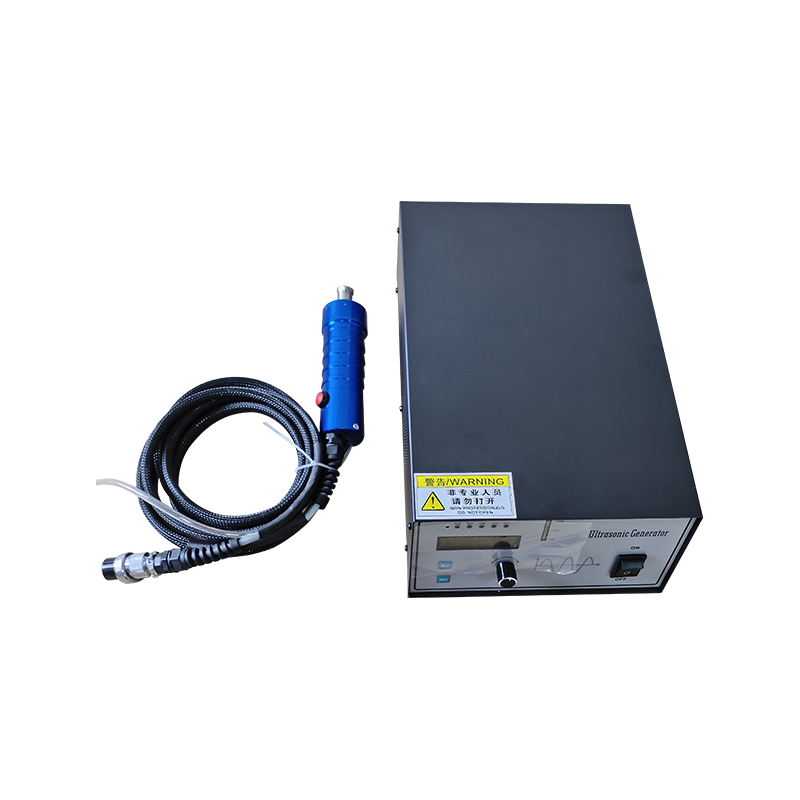
All of these machine types share the same three-component ultrasonic system: a generator that converts line frequency power to a high-frequency electrical signal, a converter (transducer) that converts the electrical signal to mechanical vibration using piezoelectric ceramics, and a sonotrode (horn) that amplifies and directs the vibration to the material surface. The differences between machine types lie in how the sonotrode contacts the material, what the mating anvil or wheel surface looks like, and how the fabric is transported through the processing zone.
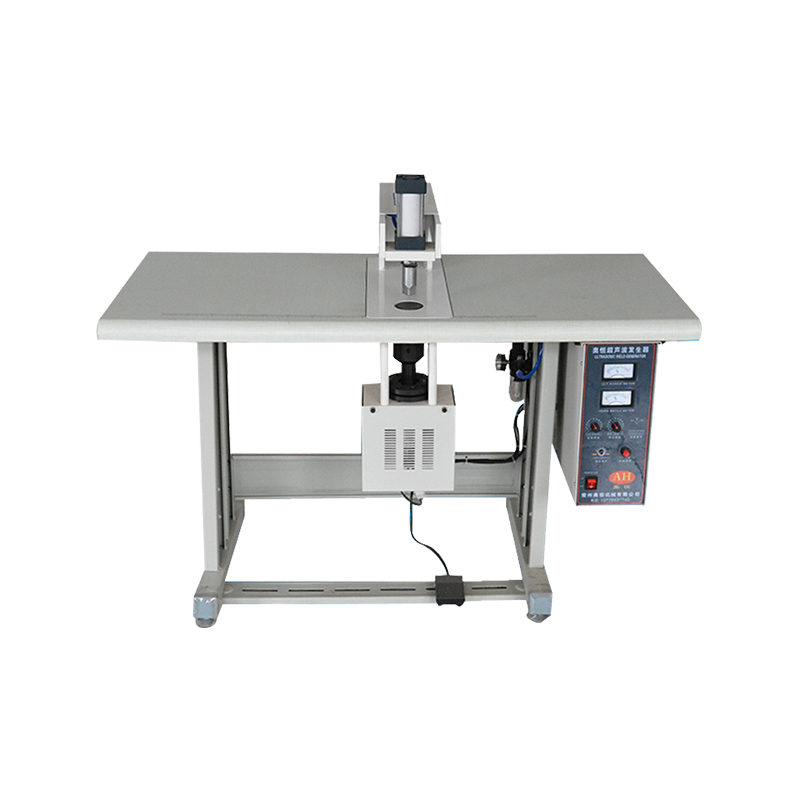
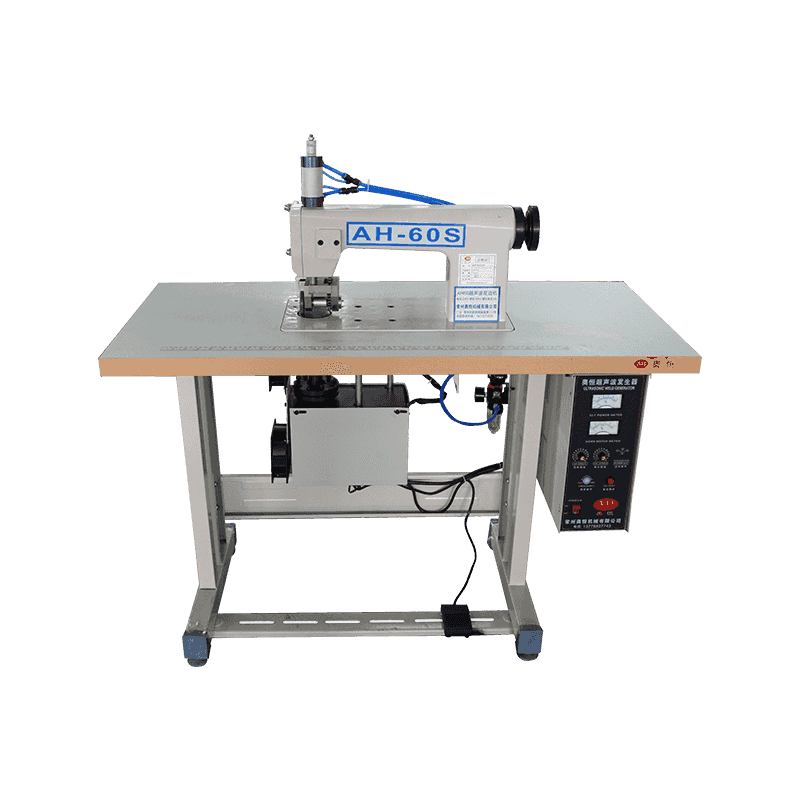
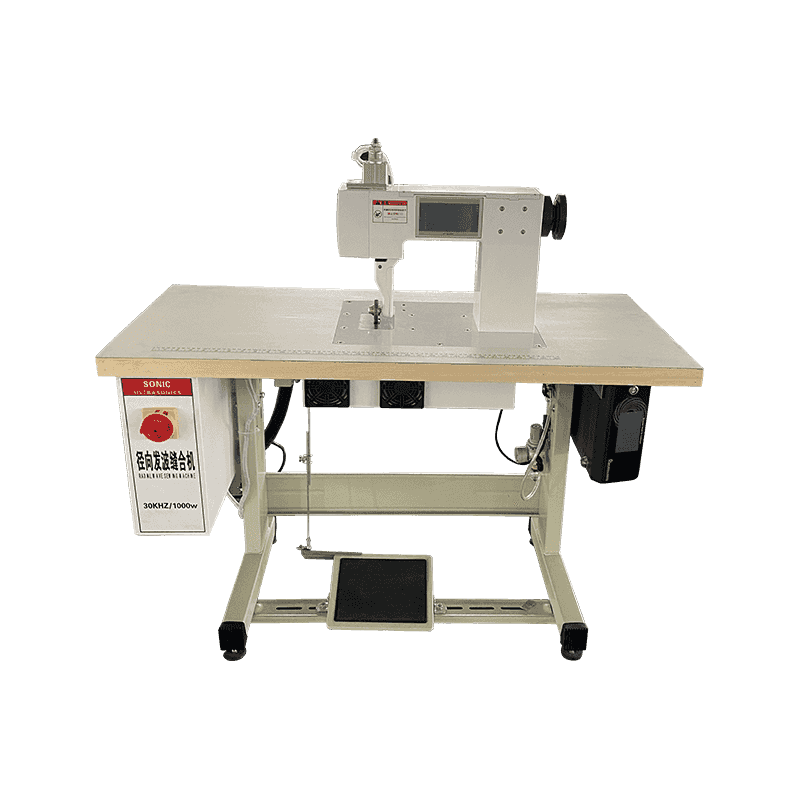
An ultrasonic sewing machine performs the joining function of a conventional sewing machine -- bonding two or more layers of fabric along a defined seam line -- without needles, thread, or bobbins. The fabric layers are fed between a continuously vibrating sonotrode and a rotating anvil wheel or fixed anvil, and the thermoplastic fibers at the contact line are fused together as the material passes through the nip.
The anvil wheel surface in a machine sewing ultrasonic application is typically engraved with a pattern of raised points or lines. As the fabric sandwich passes between the sonotrode and the anvil, the raised features concentrate the ultrasonic energy at discrete contact points, producing a seam that consists of a series of fused points or a continuous fused line depending on the anvil pattern. The appearance resembles a dotted or continuous bonded line rather than the visible stitch of a thread seam, and the bond has no thread ends to fray or loosen.
The ultrasonic sewing machine produces a seam that is simultaneously a bond and a cut in some configurations: a blade-tipped sonotrode or a cutting anvil can sever the fabric along the seam line at the same time as the bond is formed, eliminating a separate cutting operation. This simultaneous seal-and-cut function is one of the most significant production efficiency advantages of ultrasonic sewing over needle-and-thread construction in synthetic fabric processing.
Compared to a conventional sewing machine, an ultrasonic sewing machine offers several specific operational and product advantages on compatible materials:
Ultrasonic sewing machines require a minimum thermoplastic fiber content in the fabrics being joined -- typically 40% or more by weight, depending on the specific fiber type and the required bond strength. Pure natural fiber fabrics (cotton, wool, linen, silk) cannot be ultrasonically sewn because they do not melt under ultrasonic energy; they char or burn instead. Blended fabrics with sufficient synthetic content can be processed, but the bond strength will be lower than an equivalent seam in a predominantly synthetic material. For applications where the material is primarily natural fiber, a conventional sewing machine remains the appropriate technology.
Nonwoven fabrics represent the single most compatible material category for ultrasonic sewing technology. The combination of high thermoplastic fiber content, uniform fiber distribution, and the absence of a woven or knitted structure that would resist needle penetration or create stitch distortion makes nonwovens the ideal substrate for ultrasonic processing across all machine types in this family.
Spunbond polypropylene, spunlace polyester, SMS (spunbond-meltblown-spunbond) composites, and thermally bonded polyester nonwovens all consist primarily or entirely of thermoplastic fibers with no woven interlacing structure to maintain. When subjected to ultrasonic energy at the bond point, the fiber mat melts locally and the fibers from adjacent layers flow together to form an integral fused zone. The resulting bond is typically stronger than the surrounding nonwoven substrate in peel, meaning the fabric tears before the ultrasonic seam fails -- a benchmark of bond quality that is routinely achieved on well-matched material and process combinations.
The ultrasonic sewing machine for nonwovens is used across an extensive range of product categories: hygiene products (diapers, adult incontinence products, feminine hygiene), medical disposables (surgical gowns, drapes, face masks), protective clothing (coveralls, shoe covers, caps), agricultural covers and crop protection fabrics, geotextile composites, and the full range of nonwoven bag constructions discussed in the bag sealing section below.
The key process parameters for ultrasonic sewing of nonwovens are the ultrasonic amplitude (controlling energy input at the bond point), the static pressure between the sonotrode and the anvil (controlling the compression of the material during fusion), and the line speed (determining the dwell time of any given point of the material in the bonding zone). These three parameters interact: increasing line speed requires higher amplitude or pressure to maintain equivalent bond strength, while excessive amplitude or pressure at low speed will overheat and damage the nonwoven substrate. Calibration of these parameters for a specific nonwoven fabric weight and construction is done during process development and documented as the operating recipe for that material.
The ultrasonic non woven bag sewing machine is a purpose-built system for producing bags -- shopping bags, packaging bags, promotional tote bags, and industrial sacks -- from nonwoven fabric, typically spunbond polypropylene (PP), using ultrasonic bonding for all seams, handle attachment, and edge finishing operations. This machine category has grown rapidly alongside the global shift from single-use plastic bags to reusable nonwoven alternatives in retail and consumer packaging markets.
A nonwoven bag is assembled from a flat tube or a folded sheet of nonwoven fabric by seaming the side and bottom edges to form the bag body, and then attaching handles -- either cut strips of the same nonwoven material or woven PP ribbon -- at defined positions on the bag top edge. All of these joining operations can be performed ultrasonically, producing a bag with no thread, no needle holes, and sealed edges on all bonded seams.
The productivity advantage of an ultrasonic non woven bag sewing machine over a conventional sewn bag production line is most visible in high-volume operations: ultrasonic bonding cycles of 0.2 to 0.5 seconds per seam allow production rates of several hundred to over a thousand bags per hour on automated systems, compared to the lower throughput typical of multi-step sewn bag assembly. The elimination of thread management -- thread supply monitoring, breakage response, bobbin change -- also reduces labor input relative to equivalent sewn production.
Ultrasonic non woven bag sewing machines range from semi-automatic single-station systems where the operator positions the bag panels for each bonding cycle, to fully automatic rotary or linear systems where nonwoven fabric is fed from a roll, cut to panel size, folded, seamed, and handle-attached in a continuous or indexed automatic sequence. Fully automatic systems incorporate:
The ultrasonic bag sealing machine is distinct from the bag sewing machine in its primary function: where the bag sewing machine assembles the bag body from flat fabric panels, the bag sealing machine closes a pre-formed or pre-filled bag by forming a seal across its open end. This distinction reflects the two stages of bag processing -- fabrication and closing -- which may occur on the same line or in separate operations depending on the production process.
In an ultrasonic bag sealing machine, the open end of the bag (or the neck of a pouch) is fed between the vibrating sealing horn and a fixed or rotating anvil. The horn applies ultrasonic energy across the full width of the bag opening simultaneously (for plunge welding) or progressively (for continuous rotary welding), fusing the two fabric or film layers at the open end to form a hermetic or near-hermetic seal. The seal is formed and completed in a single press cycle of typically 0.1 to 0.5 seconds for plunge welding, or continuously at line speed for rotary systems.
Ultrasonic bag sealing offers specific advantages over heat bar sealing (the conventional alternative for thermoplastic bags and pouches) in applications where the material being sealed is delicate, where product contamination at the seal area would prevent heat bar contact, or where the material construction makes uniform heat conduction through the material wall difficult. Ultrasonic energy is generated within the material at the contact point rather than being conducted from an external heat source, which means that contamination on the outer surface of the bag does not prevent effective sealing of the inner thermoplastic layers -- a significant advantage in food packaging, medical device packaging, and powder or granule containment applications where product spillage at the fill point is common.
Ultrasonic bag sealing machines are available in three principal configurations, each suited to different production scales and bag types:
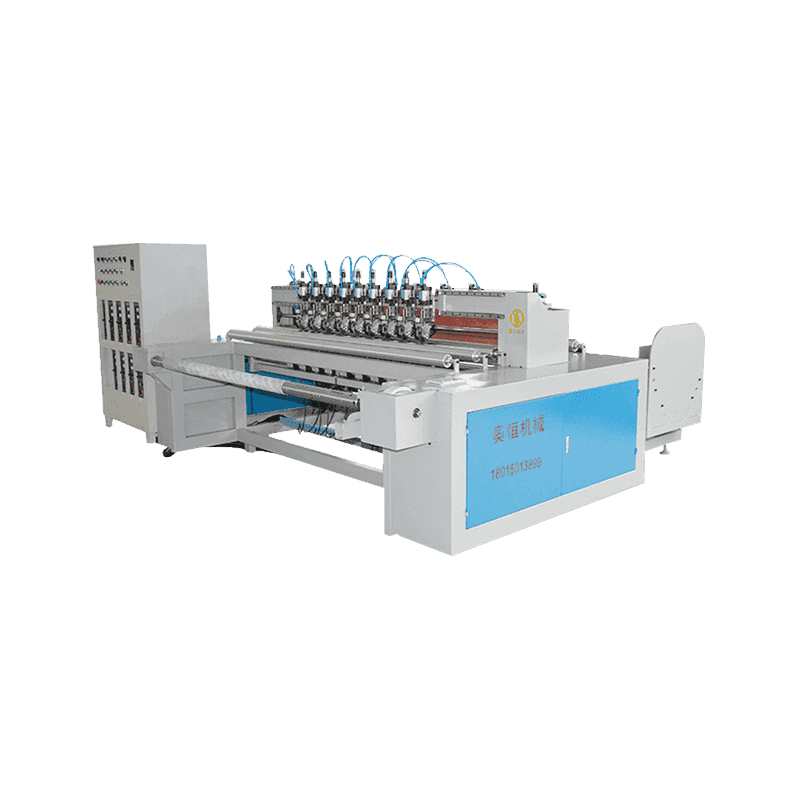
The ultrasonic sealing machine category extends beyond bag closing to encompass any application where a thermoplastic textile, film, or composite material must be bonded or sealed along a defined line or at a defined point. The same generator-converter-sonotrode system used for bag sealing is applied across a wide range of product types with different tooling configurations.
In garment and technical textile manufacturing, ultrasonic sealing machines are used for seaming waterproof outerwear (where needle holes would compromise the waterproof membrane), bonding reflective tape and heat transfer labels to synthetic garments, attaching hook-and-loop fastener tape to nonwoven or synthetic fabric without thread, and assembling multi-layer protective clothing panels. The medical textile sector uses ultrasonic sealing extensively for disposable surgical gowns, drapes, and isolation apparel where the absence of needle holes is required by barrier performance standards including EN 13795 and AAMI PB70.
Filtration products -- air filter media, liquid filter bags, HVAC pleated filter assemblies, and industrial dust collection filter elements -- are a major application for ultrasonic sealing machines. The filter medium is typically a synthetic nonwoven or microfiber fabric that must be seamed or edge-sealed without thread that would add bulk, introduce fiber contamination, or create leak paths at stitch holes. Ultrasonic sealing produces a compact, dense bond line with minimal material protrusion into the filter cavity, maintaining flow geometry and filtration efficiency while providing structural integrity for the filter element.
Automotive interior trim components including headliners, door panel fabric inserts, and trunk liners are assembled using ultrasonic sealing to join fabric face layers to foam or nonwoven backing materials. The absence of visible thread in finished interior trim, combined with the dimensional consistency of ultrasonic bond positions, makes this technology standard practice in automotive first-tier supplier facilities. Industrial applications include ultrasonic sealing of medical packaging films, protective packaging inserts, and composite material assemblies where bonding conditions preclude the use of adhesives or heat bar sealing.
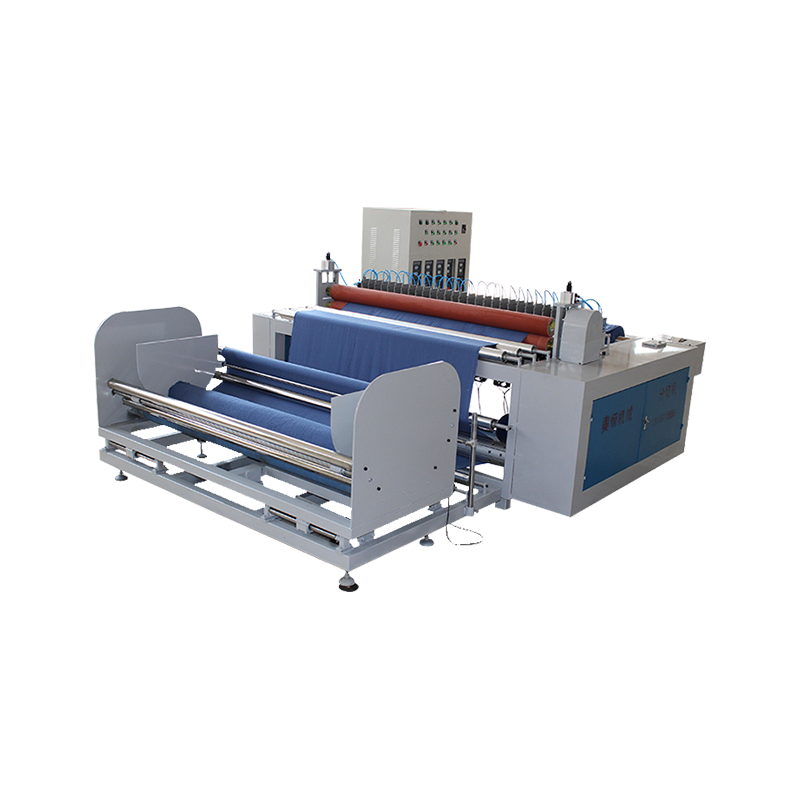
The ultrasonic lace machine and the lace cutting machine represent two closely related applications of ultrasonic technology to the production and processing of lace-effect fabrics and decorative edging materials. Both types use engraved pattern wheels or sonotrodes to apply ultrasonic energy in defined patterns, but their primary functions differ.
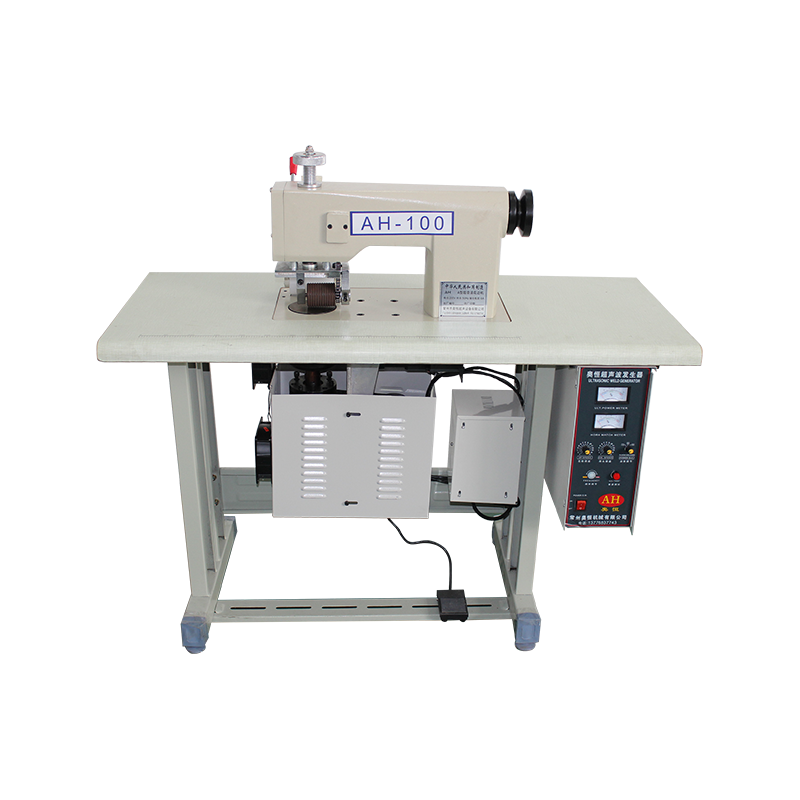
An ultrasonic lace machine uses a patterned engraved wheel rotating against a sonotrode to create a decorative bonded pattern in a synthetic or blended fabric -- typically a nonwoven, a woven polyester, or a fabric with a thermoplastic surface coating. The raised pattern on the engraved wheel concentrates ultrasonic energy at the pattern contact points, fusing the fabric at those points while leaving the surrounding area unbonded. When the unbonded areas are subsequently cut away (by the ultrasonic cutting function of the same machine, by a separate die cutter, or by laser cutting), the fused pattern forms the structural lace element -- a decorative openwork structure held together by the bond points rather than by woven or knitted interlacing.
Ultrasonic lace machines can produce lace-effect decorative fabrics and edging tapes at production speeds and material costs that are significantly lower than traditional mechanical lace weaving, making them the dominant technology for decorative edging on synthetic lingerie, nightwear, babywear, and home textile products in mass-market manufacturing. Pattern wheel designs range from simple scalloped edge profiles to complex floral and geometric repeats, and wheel changes allow pattern switching in minutes without downtime for machine reconfiguration.
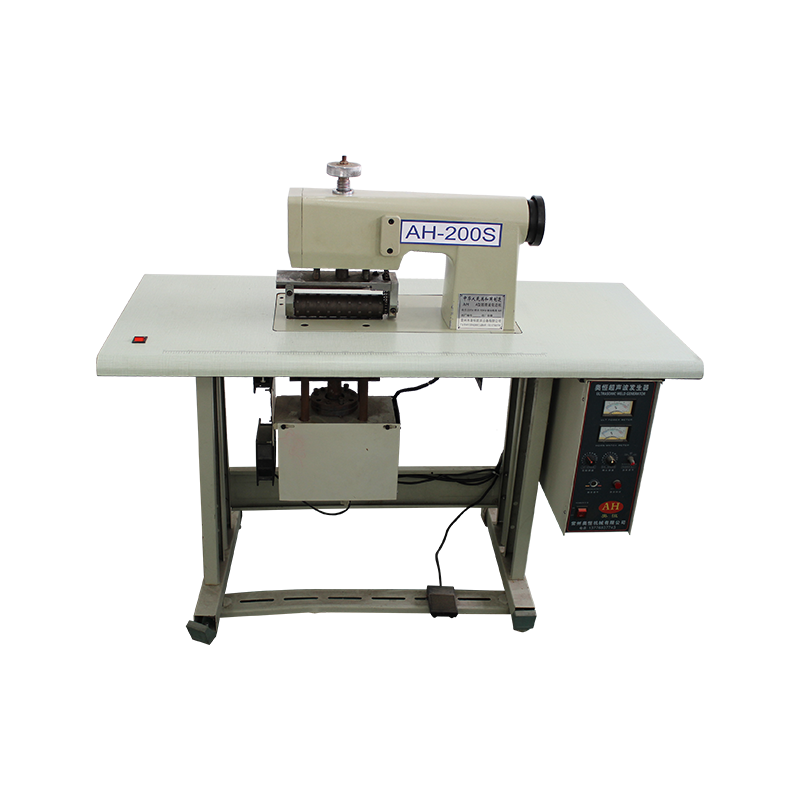
The lace cutting machine uses ultrasonic energy primarily for cutting and edge sealing rather than for pattern bonding. A sonotrode with a cutting blade tip or a narrow engraved cutting wheel severs the fabric along a defined line and simultaneously fuses the cut edges of the thermoplastic fibers, preventing fraying without a separate serging or binding operation. This simultaneous cut-and-seal function is the defining capability of an ultrasonic lace cutting machine and what differentiates it from mechanical rotary cutting, cold die cutting, or laser cutting for lace and synthetic fabric edge finishing.
Lace cutting machines are used to:
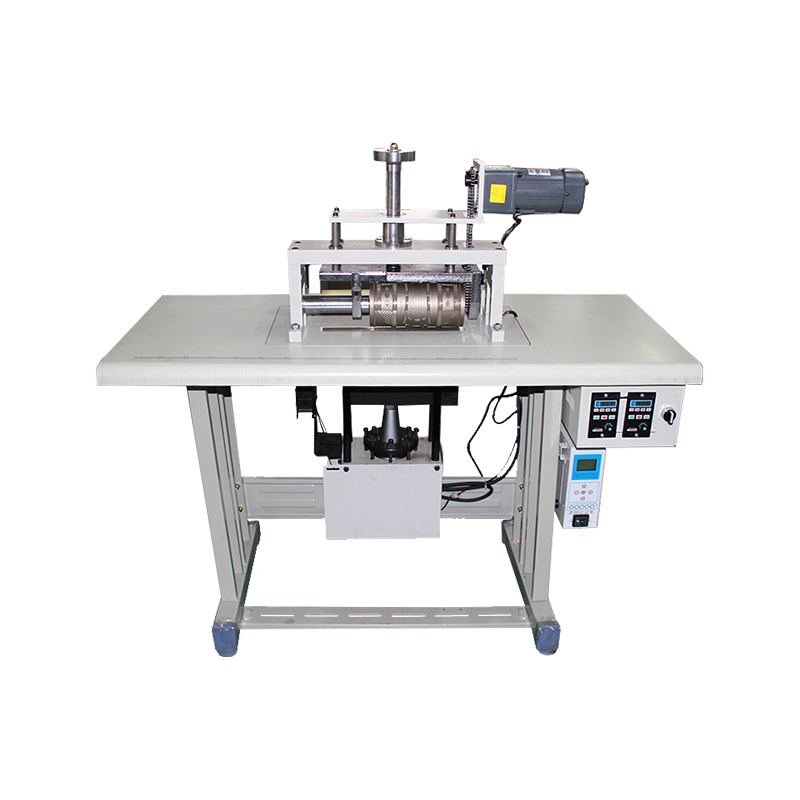
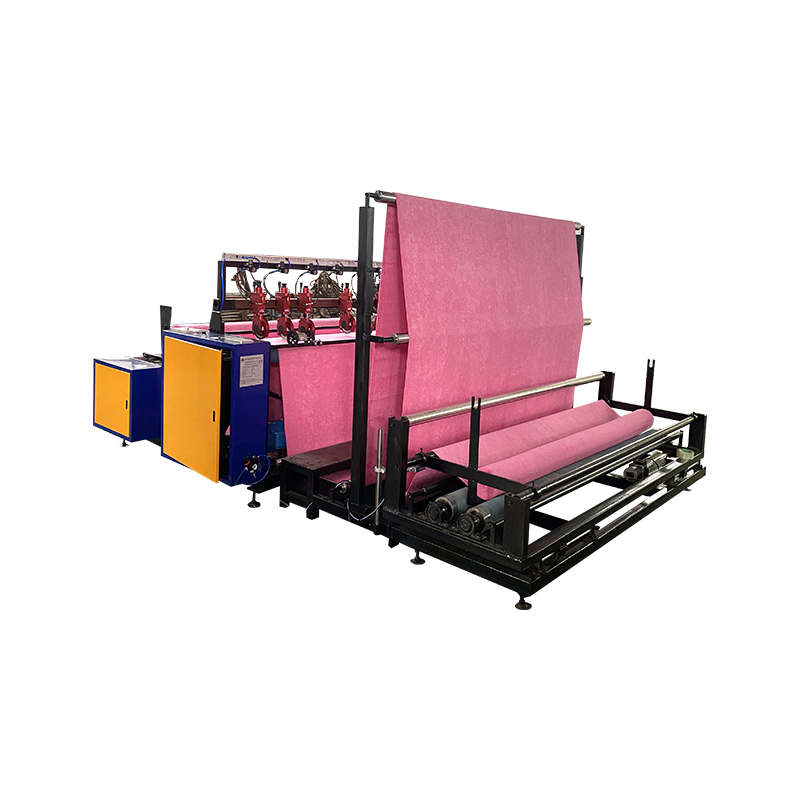
An ultrasonic embossing machine uses the combination of ultrasonic vibration and mechanical pressure from an engraved wheel or plate to create a permanent three-dimensional pattern in a thermoplastic fabric or film surface. Unlike a non-ultrasonic embossing press that uses heat and pressure alone to form a pattern, an ultrasonic embossing machine generates the heat for pattern formation internally within the material at the contact points, allowing faster cycle times, more precise energy control, and the ability to emboss materials that cannot be uniformly heated by external contact methods.
In conventional thermal embossing, the engraved roller or plate must be uniformly heated to the softening temperature of the thermoplastic material, which requires warm-up time, careful temperature control across the full roller width, and a controlled cooling zone after the nip to set the pattern before the material exits under tension. Ultrasonic embossing generates heat instantaneously at the point of contact, eliminating the warm-up period and the temperature uniformity requirements of the heated roller while providing localized energy delivery that can produce sharper, deeper embossed features in thinner materials than conventional thermal embossing can achieve.
The combination of compression from the engraved wheel and ultrasonic energy at the nip point permanently deforms the thermoplastic fibers or film at the pattern contact points, creating a raised and recessed surface pattern that is durable through subsequent processing, washing, and use. On nonwoven fabrics, ultrasonic embossing simultaneously bonds the fiber layers at the embossed points and creates the visual surface pattern -- performing both the structural bonding function of the nonwoven fabric and the decorative patterning function in a single pass.
Ultrasonic embossing machines are used across the following product categories:
| Machine Type | Primary Function | Sonotrode / Anvil Configuration | Typical Materials | Key Applications |
|---|---|---|---|---|
| Ultrasonic sewing machine | Seaming fabric layers | Flat sonotrode, engraved anvil wheel | Synthetic wovens, nonwovens, films | Garment seams, technical textile joints |
| Ultrasonic sewing machine for nonwovens | Bonding nonwoven layers | Optimized for low basis weight substrates | PP, PET, SMS nonwovens | Hygiene, medical, protective garments |
| Ultrasonic non woven bag sewing machine | Assembling nonwoven bags | Multiple bonding stations, handle attachment | Spunbond PP nonwoven | Shopping bags, tote bags, packaging |
| Ultrasonic bag sealing machine | Closing pre-formed bags | Full-width bar sonotrode, flat anvil | Nonwoven, film, laminate | Food, medical, industrial packaging |
| Ultrasonic sealing machine | Bonding or sealing along defined lines | Line or point sonotrode, fixed or rotary anvil | Synthetic textiles, films, composites | Waterproof garments, filters, medical textile |
| Ultrasonic lace machine | Creating decorative bonded patterns | Patterned engraved wheel against sonotrode | Synthetic nonwoven, polyester fabric | Lingerie edging, nightwear trim, home textiles |
| Lace cutting machine | Cutting and sealing edges simultaneously | Blade or narrow cutting wheel sonotrode | Synthetic lace, nonwoven, film | Lace slitting, shaped edge trim, applique cutting |
| Embossing machine | Creating permanent surface patterns | Engraved pattern wheel, sonotrode nip | Nonwoven, film, thermoplastic composites | Hygiene products, wipes, decorative nonwovens |
For manufacturers and procurement teams evaluating ultrasonic textile processing equipment, the following framework covers the parameters that most directly determine whether a given machine configuration will meet the production requirements of a specific application.
The operating frequency of the ultrasonic system -- typically 20 kHz for high-power heavy-duty applications and 35 to 40 kHz for lighter fabrics and precision applications -- affects the amplitude of sonotrode vibration and the acoustic behavior of the tooling. Higher frequency systems operate at lower amplitude for the same power level, making them more suitable for delicate fabrics and precise pattern work; lower frequency systems deliver higher amplitude and are used for thicker, denser materials and higher-throughput production. Generator power (expressed in watts) must be matched to the material thickness, width, and bonding area to ensure adequate energy delivery at the target line speed.
The sonotrode and anvil wheel are precision-machined components resonant at the operating frequency of the generator. Sonotrodes are typically manufactured from titanium (preferred for its combination of acoustic properties, fatigue strength, and corrosion resistance) or aluminum (lower cost, shorter service life). Pattern wheels are produced in hardened tool steel with engraved or EDM-machined surface patterns. The cost of tooling -- particularly custom pattern wheels for specific lace or embossing designs -- is a significant procurement consideration that should be factored into the total cost of ownership evaluation alongside the machine capital cost.
Before finalizing equipment specification, particularly for ultrasonic sewing and sealing applications where bond strength is a product performance requirement, material trials at the machine supplier's facility with production-representative fabric samples are strongly recommended. The interaction between the specific nonwoven or synthetic fabric construction and the ultrasonic bonding parameters cannot be fully predicted from material data sheets alone, and processing trials allow the supplier to confirm achievable bond strength, line speed, and pattern quality for the actual production materials before the equipment order is placed.
The appropriate automation level for an ultrasonic machine installation depends on production volume, product variety, and labor availability. Semi-automatic systems with manual loading offer lower capital cost and greater flexibility for multi-product or low-volume operations. Fully automatic systems with integrated feeding, cutting, and stacking deliver the highest throughput and lowest labor cost per unit but require higher capital investment and are most economical when running a defined range of products at sustained high volume. Integration requirements -- communication with upstream and downstream equipment, production monitoring and data logging, recipe management for multiple product specifications -- should be defined before equipment specification to ensure the control system architecture matches the facility's production management approach.

Copyright © ChangZhou AoHeng Machinery Co., Ltd. All Rights Reserved