English
 中文简体
 русский
 Español
Home / Blog / Industry News / Ultrasonic Welding: Process, Materials, Tooling, and Practical Setup Tips


Request A Quote
Ultrasonic welding is a joining process that uses high-frequency acoustic vibration to create heat at the interface between two parts. The vibration is applied locally, under pressure, and the materials fuse without the bulk melting that happens in conventional welding. It is a practical method for thermoplastics, nonwovens, films, and certain metals, and it has become a familiar sight on production lines where clean, fast, and repeatable bonds matter. At Changzhou Aoheng Machinery, ultrasonic welding is not an abstract topic; it is the principle behind machines we build for textile, nonwoven, disposable-product, and plastic-part manufacturers. The useful part is understanding what the process needs from the material, the tooling, and the setup, so a good weld is repeatable rather than accidental.
Content
An ultrasonic welding system has a straightforward stack: a power supply, a transducer, a booster, a sonotrode or horn, and an anvil or fixture. The transducer converts electrical energy into mechanical vibration, the booster adjusts amplitude, and the horn delivers that vibration to the workpiece. The anvil holds the part and shapes the contact point. A typical cycle runs through six steps:
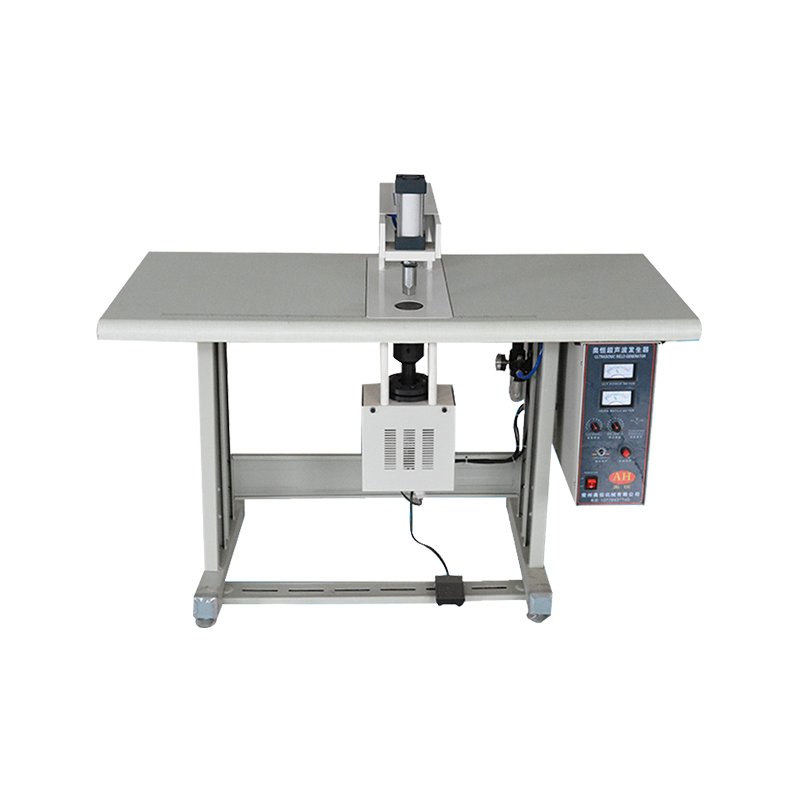
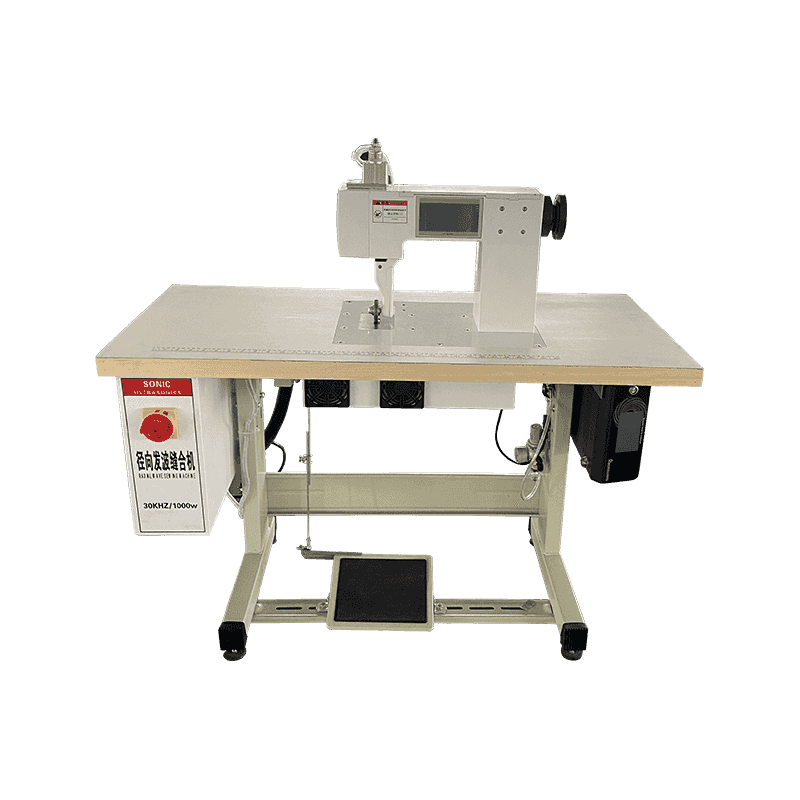
Frequency, amplitude, force, weld time, and hold time are the main parameters. A 20 kHz system is common for robust plastic parts, while 30 to 40 kHz is often chosen for finer work. Higher amplitude is not automatically better; too much can mark the surface, damage fibers, or crack brittle parts. Hold time matters as much as weld time because the joint must cool under pressure before the horn retracts. For spot joining and small plastic assemblies, a dedicated bench-mounted unit can make setup and repeatability much easier, and the AH50Q ultrasonic spot welding machine is a practical example of that approach.
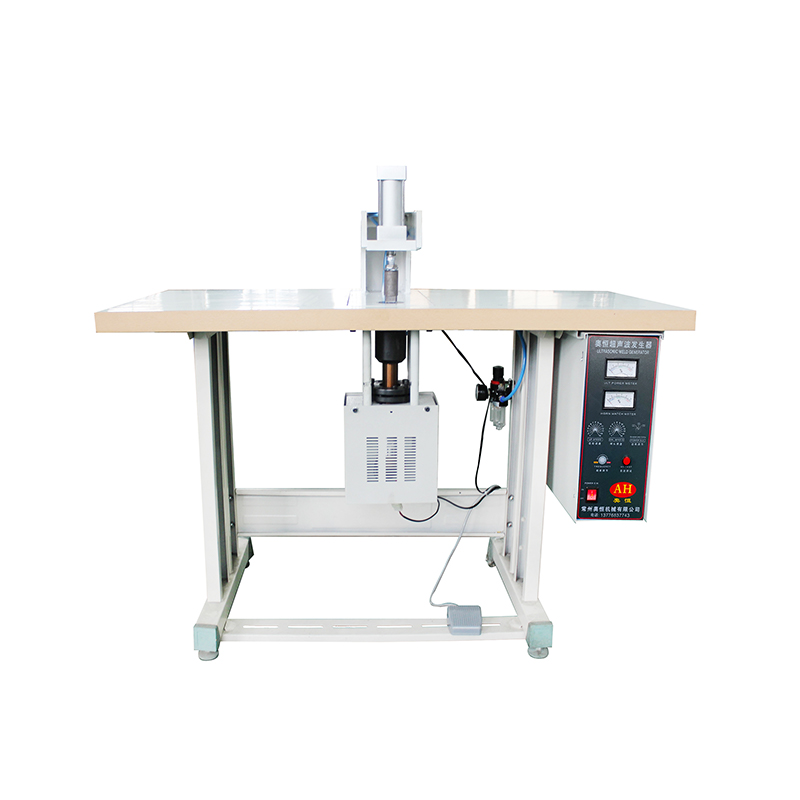 AH-50Q Ultrasonic Spot Welding Machine for Textile AssemblyBench-mounted spot welder for nonwoven handbags, mask ear loops, and plastic assemblies, with foot-pedal control and pattern molds for repeatable joins.View Product →
Material behavior decides whether ultrasonic welding is a good fit. Amorphous thermoplastics generally transmit vibration well; semi-crystalline resins can weld but usually need tighter process windows. Nonwovens and films bond through localized fiber or surface fusion, while thin metals join through solid-state deformation rather than melting. The table below gives a practical starting point, but exact results depend on grade, thickness, additives, and tooling.
| Material group | Typical examples | What to watch |
|---|---|---|
| Thermoplastics | ABS, PP, PE, PC, acrylic, nylon | Amorphous resins are often more forgiving than semi-crystalline grades; moisture and fillers matter. |
| Nonwovens and films | PP, PE, and PET blends | Bonding depends on local fiber fusion; horn and anvil pattern affect hand and appearance. |
| Packaging | Coated board, foil laminates, polymer films | Surface contamination is the enemy; sealing pressure and dwell need to be consistent. |
| Metals | Aluminum, copper, thin foils | Solid-state joining requires clean, oxide-free surfaces and rigid support. |
| Dissimilar combinations | Compatible plastic pairs | Mismatched melting points and thermal expansion call for joint trials before production. |
If you are unsure whether a resin or laminate will weld cleanly, start with a small sample run and inspect the joint under load. We keep a longer set of material compatibility notes in our technical library for teams that need a deeper starting point.
Tooling is where many ultrasonic welding projects succeed or fail. A horn designed for one joint may be wrong for another, and a fixture that flexes will steal energy from the weld. Joint design also matters. An energy director concentrates vibration at the initial contact line, a shear joint provides an interference fit for stronger sealed assemblies, and tongue-and-groove layouts help align parts. For textiles and nonwovens, the horn face and anvil pattern control bond appearance, softness, and edge quality. A worn horn or a poorly supported anvil can produce inconsistent bonds even when the machine settings look correct.
For textile and nonwoven work, the horn profile and anvil pattern often decide whether the bond feels soft, flat, or decorative. Our textile-optimized welding horns are built with that balance in mind, and they are one of the quieter reasons a production line stays consistent.
 AH Textile-Optimized Ultrasonic Welding HornsUltrasonic horn accessory for textile welding or cutting, offered in multiple amplitudes and frequencies to support consistent energy transfer in nonwoven and fabric processing.View Product →
Before changing the machine, check the basics. Most welding problems are not mysterious; they are a loose fixture, a dirty surface, or a parameter that drifted.
Ultrasonic welding shows up wherever heat, adhesives, or stitches are inconvenient. In textiles and nonwovens, it is used for lace effects, hemming, quilting, slitting and sealing, and composite bonding. In disposable products, it joins shoe covers, caps, pillowcases, gloves, and sanitary napkins without sewing thread. Packaging teams use it for seals and tamper-evident joints, while automotive and electronics manufacturers use it for small plastic assemblies and wire termination. Medical production relies on it when a clean, repeatable bond matters.
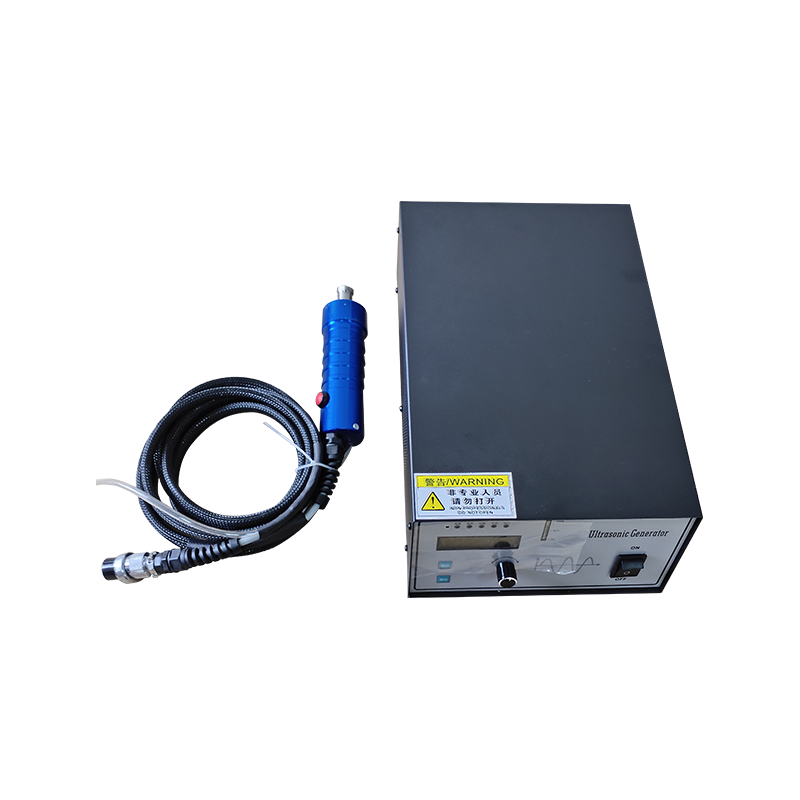
In our own product range, the same principles appear in ultrasonic lace machines, quilting machines, slitting and crosscutting machines, disposable-product machines, and dedicated welding units. Our ultrasonic welding machine range covers handheld, spot, placket, and plastic welding formats, so the right starting point depends on the joint rather than on a single machine type. For field repairs, sampling, or short runs, a handheld ultrasonic welder such as the AH30 gives you a useful bridge between the bench and the production line.
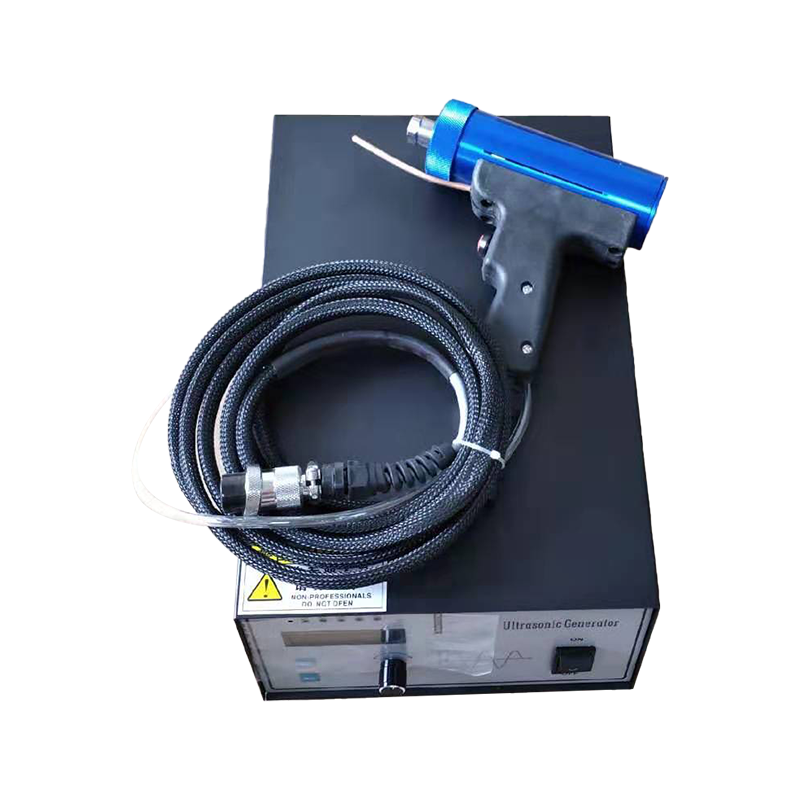 AH-30 Handheld Ultrasonic Spot Welder for Field and Short RunsPortable 28/35 kHz ultrasonic welder for spot joining thin plastics, nonwovens, and wires, suited to repairs, sampling, and short production runs.View Product →
Ultrasonic welding is generally clean, but it is not risk-free. High-frequency vibration can affect hearing over time, so enclosures and hearing protection are worth taking seriously. Keep hands away from the horn and anvil during cycling, use lockout procedures during tooling changes, and provide ventilation or fume extraction when working with plastics that release volatiles. On the maintenance side, check horn wear, transducer cooling, cable condition, and fixture alignment on a regular schedule. A common misstep is chasing more power when the real issue is a worn horn, a flexing fixture, or inconsistent part dimensions. Another is assuming that a weld that looks good will hold under load; a simple pull or peel check catches more problems than a visual inspection.
Choosing equipment starts with the material and the joint, not the catalog page. Ask what the parts are made of, how thick they are, how much weld area is involved, and what cycle time the line needs. Then consider the level of automation: a handheld unit may be enough for repairs and low-volume work, while a fixture-based machine with controlled force, time, and hold is better for production consistency. Tooling support matters too, because horns and fixtures are not universal. At Changzhou Aoheng Machinery, we build ultrasonic equipment for textile, nonwoven, disposable-product, and plastic applications, and we have supplied customers in more than thirty countries. That experience is useful when a standard machine needs a custom horn, a different anvil, or a fixture tailored to an awkward part shape.
If you are weighing a new ultrasonic process, the most reliable next step is a sample trial with the actual material and joint geometry. Bring us the part, the failure mode, and the production target, and we can help you narrow down the machine format, the tooling, and the process window. Ultrasonic welding rewards preparation, and a calm, well-supported setup usually beats a long list of machine features.

Copyright © ChangZhou AoHeng Machinery Co., Ltd. All Rights Reserved