English
 中文简体
 русский
 Español
Home / Blog / Industry News / ultrasonic horn: Applications, Selection Criteria, and Practical Guidance


Request A Quote
Ask anyone who has run an ultrasonic cutting, quilting or sealing line for a few years what they check first when a seam looks weak or a cut edge starts to fray, and the answer is usually the horn. It is the visible, tangible end of the whole system — the piece of tuned metal that actually touches the material — and it takes most of the blame when results start to drift. In our experience building ultrasonic machinery for textile, nonwoven and disposable-product producers, a fair share of "horn problems" turn out to be a mismatch between the horn and the job rather than a part that has simply worn out.
This guide walks through what an ultrasonic horn does, how its material and shape change performance, and what to look at when you are choosing a new one or replacing a tired one.
Content
An ultrasonic horn — also called a sonotrode, a tool or a probe, depending on the supplier — is the last component in a three-part mechanical stack. The converter turns the generator's high-frequency electrical signal into mechanical vibration, usually at 15 kHz, 20 kHz or 40 kHz. The booster steps that amplitude up or down to suit the process. The horn then delivers the vibration to the workpiece through a working face shaped for the task: a narrow blade for cutting, a wide flat or patterned face for bonding and embossing, a profiled roller for continuous sealing.
Every horn is a resonator. It is machined to be a half-wavelength long at its design frequency, so the vibration arriving at its input is amplified and delivered at the output face. Change the length, the taper, the slot pattern or even the alloy, and the resonant frequency moves with it. That is why a horn cannot simply be copied in a different material, and why a horn that has been heavily polished or refaced may no longer tune cleanly. It also explains why the mating surfaces between converter, booster and horn must be flat and clean, and why the threaded stud should be tightened to the torque the manufacturer specifies — a loose joint turns vibration into heat and noise, while an over-tightened one can crack the stud seat.
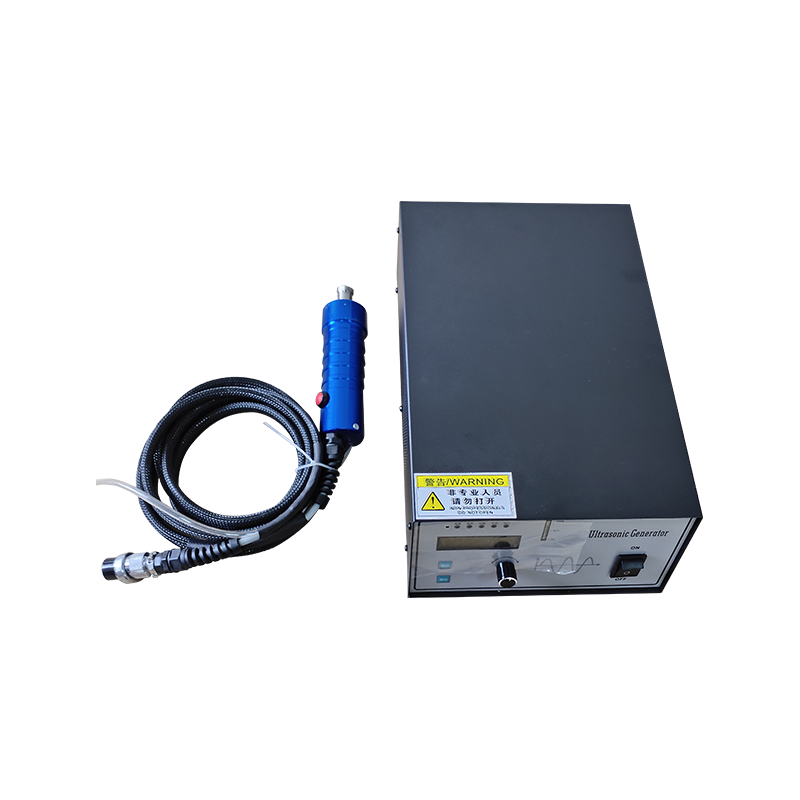
 Transducer and Aluminum Joint for Ultrasonic Machine StackCombines a piezoelectric transducer with a lightweight aluminum joint to connect stack components, making the mating joint worth checking for stable tuning.View Product →
The joint between horn and transducer deserves particular attention on machines that run three shifts. It is a small, inexpensive part that quietly decides whether the whole stack stays in tune.
Three families of material cover most industrial horns, and choosing between them is a balance of fatigue life, acoustic efficiency, wear resistance and cost. In broad terms:
| Material | Acoustic and mechanical behaviour | Wear resistance | Where it usually makes sense |
|---|---|---|---|
| Titanium alloy | High fatigue strength, low acoustic loss, stable at high amplitude | Good | Continuous-duty welding, cutting and quilting; high-amplitude work |
| Aluminum alloy | Light, easy to machine, higher internal loss, softer face | Moderate | Moderate amplitude, cost-sensitive tooling, textile cut-and-seal |
| Hardened steel | Tough and dimensionally stable, but higher acoustic loss | High | Blade-type working faces and jobs where toughness matters most |
| Carbide or ceramic facing | Face insert on a tuned body; brittle under shock loads | Very high | Abrasive filled nonwovens and long runs with minimal downtime |
Titanium has become the default for demanding work because it holds amplitude without cracking and loses relatively little energy as heat. Aluminum alloy is not a compromise to be ashamed of: on many textile cut-and-seal stations, a well-designed aluminum horn gives years of service at a fraction of the cost, provided the amplitude and the fabric are not punishing. Steel and faced horns enter the picture when the working face is being abraded faster than the body wears out.
Profile matters as much as alloy. The main families we see in production are:
Gain, uniformity and mechanical strength pull against each other. A very high-gain horn delivers more amplitude but is more sensitive to load and to tuning drift; a wide, slotted face is gentler on the material but harder to design. This is where a supplier who has already built horns for your kind of fabric is worth more than a catalogue page.
Textile work puts a horn in an unusual position. Instead of short welding cycles, it often runs continuously for hours against an anvil roller, sealing a seam or trimming an edge at line speed. Heat builds up in the horn rather than in the material, and any imbalance in amplitude across the face shows up as an uneven seam or a ragged edge on one side of the web.
For these jobs we look at three things first: the amplitude the process actually needs, the width of the working face relative to the anvil pattern, and how much abrasive filler the fabric contains. Spunbond and meltblown materials behave very differently from a coated woven fabric, and a horn tuned for one will not necessarily give a clean cut on the other. When the fabric is heavily filled, a coated or faced horn usually pays for itself in reduced re-facing downtime.
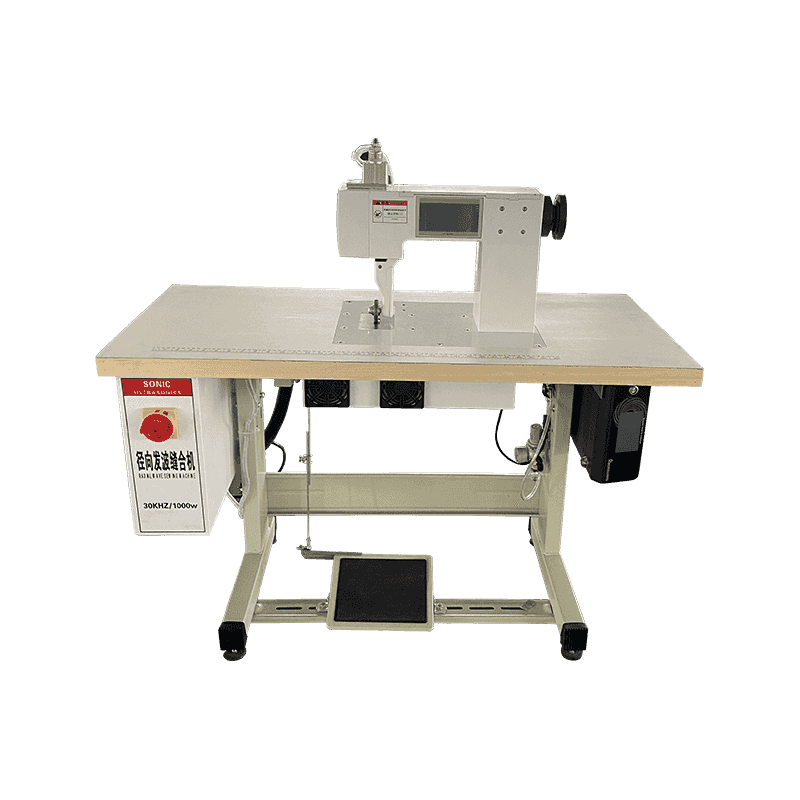
 Textile-Optimized Ultrasonic Welding Horns for CuttingWelding horns offered in multiple amplitudes and frequencies for textile cutting or welding, suited when fabric behavior and working-face width drive horn selection.View Product →
Sooner or later a project arrives that no catalogue horn fits: a sealing pattern that has to match a decorative emboss, a face profile that must follow a curved anvil, a cut line that has to pass within a millimetre of a finished edge. In those cases the horn is designed backwards from the finished part — the pattern is defined first, then the body is tuned around it so the working face still resonates evenly.
Custom horns are also common where a machine is being adapted for a new product rather than replaced. Re-tooling an existing ultrasonic station with a purpose-built horn is often far cheaper than buying a second machine, and it keeps the operators on equipment they already know.
 Custom Ultrasonic Molds for Welding, Cutting, and SealingHigh-precision custom molds in industrial-grade steel, sized to customer needs for ultrasonic welding, cutting, or sealing when adapting an existing station.View Product →
A horn rarely fails dramatically. It drifts: the face polishes, the edge rounds over, a stud seat develops a hairline crack, and suddenly the seam needs more pressure or the cut needs a slower line speed to stay clean. A few habits keep that drift under control.
When a horn does need attention, re-facing and re-tuning should be treated as one operation. Skimming the face changes the resonant length, so a horn that is refaced without being checked for frequency may run hot, draw more current, and shorten the life of the converter behind it. Understanding how the whole tooling chain behaves together, including the anvil and the fixture, is worth more than any single specification sheet — our notes on tooling and fixturing for ultrasonic welding go into that in more detail.
Replacement horns, boosters, joints and mould components in our ultrasonic machine accessories range are built to the same drawings as the original tooling, so a spare can be swapped in without re-tuning the whole stack from scratch.
If you are specifying a horn — or trying to work out why the current one underperforms — these questions usually settle the matter quickly:
An ultrasonic horn is a small part of a machine and a large part of its results. Get the material, profile and tuning right and the rest of the line becomes remarkably forgiving; get them wrong and every other setting seems to fight you. If you are unsure which horn suits a fabric, a pattern or a machine you already own, send us the details — the frequency, the working width, the material and what the finished edge or seam should look like — and we will tell you honestly whether a standard horn will do the job or whether it needs to be designed from your part backwards.

Copyright © ChangZhou AoHeng Machinery Co., Ltd. All Rights Reserved