English
 中文简体
中文简体 русский
 Español
Home / Blog / Industry News / How Does the Glue Coating Function in a Sanitary Napkin Machine Work — and Why Does It Matter for Product Quality?


Request A Quote

Content
In the manufacturing of sanitary napkins, glue coating is not a secondary or cosmetic step — it is a structurally critical process that directly determines how layers bond together, how the product behaves during use, and how reliably it performs under real-world conditions. A sanitary napkin machine equipped with a glue coating function integrates precision adhesive application into the production line, allowing multiple material layers to be bonded at high speed without compromising the integrity of delicate non-woven fabrics, absorbent cores, or leak-proof backsheets.
Modern sanitary napkin machines typically handle several distinct layers simultaneously: a soft topsheet (usually non-woven or perforated film), an absorbent core (wood pulp, SAP, or composite), a diffusion layer, a leak-proof PE backsheet, and a release paper covering the positioning adhesive on the outer surface. Each of these layers must be bonded at precise positions with precise amounts of adhesive. The glue coating system is what makes this multi-layer bonding possible at production speeds that can exceed 400 pieces per minute on high-end equipment.
The glue coating function in a sanitary napkin machine operates through a series of coordinated mechanical and thermal subsystems. Understanding the step-by-step process clarifies both why it's engineered the way it is and where quality deviations are most likely to occur.
The most common adhesive used in sanitary napkin production is hot melt adhesive (HMA) — a thermoplastic material that is solid at room temperature and becomes flowable when heated, typically between 140°C and 180°C depending on the formulation. The machine's glue system includes a heated tank or drum melter that brings the adhesive to its working temperature. A gear pump or piston pump then pressurises the molten adhesive and delivers it to the application head through insulated, temperature-controlled hoses. Maintaining consistent temperature across the entire delivery path is essential — even a 10°C deviation can change the adhesive's viscosity significantly, resulting in uneven application.
Sanitary napkin machines use several application methods depending on which layer is being bonded and what coverage pattern is required:
Advanced machines incorporate multiple application heads at different positions along the production line, each configured for a specific coating method matched to the layer being processed at that point.
One of the most technically demanding aspects of glue coating in high-speed production is synchronisation. The adhesive must be applied at the exact moment the substrate passes beneath the application head — not a fraction of a second early or late. Modern sanitary napkin machines use PLC (Programmable Logic Controller) systems to coordinate glue gun firing with the machine's line speed in real time. Servo-driven glue guns can respond to speed changes within milliseconds, maintaining precise adhesive placement even as production speed ramps up or adjusts. This level of control is what separates industrial-grade machines from lower-end equipment that applies glue continuously regardless of substrate position, leading to waste and inconsistent bonding.
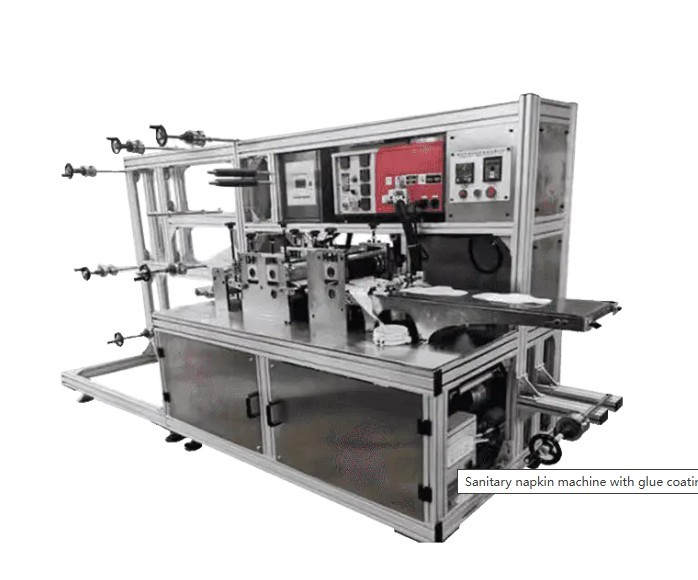
A complete glue coating system on a sanitary napkin machine is composed of several interdependent components. The quality and precision of each component has a direct bearing on the consistency of the finished product.
| Component | Function | Impact on Quality |
|---|---|---|
| Melting Tank | Heats and liquefies hot melt adhesive | Temperature inconsistency causes viscosity variation and uneven bonding |
| Gear Pump | Delivers adhesive at controlled pressure and flow rate | Pump wear causes flow rate fluctuation and inconsistent coat weight |
| Heated Hoses | Transport molten adhesive to application heads | Heat loss in transit causes premature solidification and blockages |
| Application Head / Nozzle | Deposits adhesive onto substrate in the required pattern | Clogged or worn nozzles produce voids, streaks, or excess bleed |
| PLC Control Module | Synchronises glue application with machine speed | Poor synchronisation results in misaligned adhesive zones and bond failures |
The glue coating system is not an isolated subsystem — its performance has cascading effects on nearly every quality attribute of the finished sanitary napkin. Understanding these connections allows manufacturers to diagnose product quality issues and trace them back to root causes in the adhesive application process.
The most fundamental quality impact of the glue coating system is on interlayer bonding strength. If adhesive is applied too lightly, layers delaminate during use — the topsheet separates from the absorbent core, or the core shifts within the outer structure. This is both a performance failure and a comfort issue, as a shifting core provides uneven absorption and increases leakage risk. Conversely, over-application of adhesive can stiffen the product, reduce the breathability of the topsheet, and create uncomfortable stiffness or noise during movement. Optimal coat weight — measured in grams per square metre (gsm) — is a precisely calibrated value for each layer and adhesive formulation.
The positioning adhesive applied to the outer backsheet must meet a specific and narrow performance window: strong enough to hold the napkin securely in underwear without slipping during physical activity, yet gentle enough to be removed cleanly without damaging fabric. This balance is determined by both the adhesive formulation and the precision of application. Bead width, placement accuracy, and coat weight all affect peel strength. Machines with inconsistent glue gun timing produce positioning adhesive strips that are too short, misaligned with the designed placement zone, or of variable thickness — all of which lead to products that either fail to stay in place or are difficult and unpleasant to remove.
The glue coating method used for inner layers — particularly the topsheet and acquisition layer bond — has a direct effect on how soft and flexible the finished product feels. Spiral spray application creates an open, fibrous adhesive network that preserves the drape and softness of non-woven materials. Full-coverage slot die application on these same layers would create a rigid, plastic-like laminate that is stiff and uncomfortable against skin. Selecting the right coating method for each bonding zone, and calibrating it precisely, is what allows high-quality sanitary napkins to feel simultaneously secure and gentle.
In sanitary napkins that incorporate superabsorbent polymer (SAP) particles within the absorbent core, glue coating plays a critical role in preventing SAP migration. A thin adhesive layer applied over the SAP-containing layer holds the particles in their designed position, preventing them from clustering at one end of the napkin or escaping through the edges during use. Without this targeted adhesive application, SAP-based cores produce inconsistent absorption and can cause localised saturation — a leading cause of side-leakage complaints from end users.
Quality control in sanitary napkin production includes systematic inspection of glue coating consistency. The following are the most commonly encountered defects associated with glue coating system issues:
Preventive maintenance schedules — including daily nozzle cleaning, weekly pump inspections, and periodic temperature calibration checks across all heated zones — are the most effective way to maintain glue coating consistency and avoid these defects at production scale. Manufacturers who invest in machines with real-time coat weight monitoring sensors gain a significant advantage, as deviations are flagged and corrected automatically without requiring manual line stops.

Copyright © ChangZhou AoHeng Machinery Co., Ltd. All Rights Reserved